Rental scams in Switzerland: check these red flags first
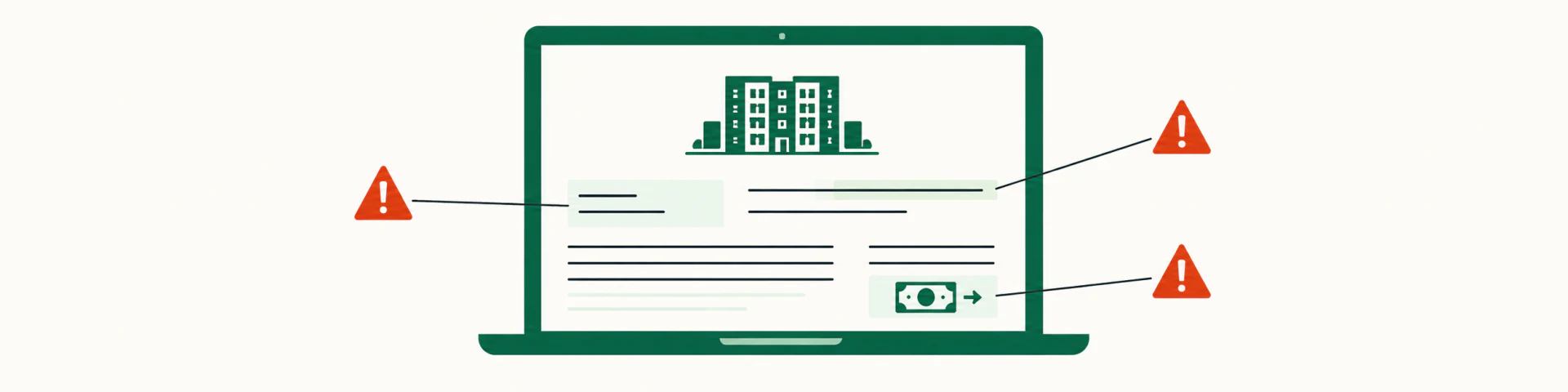
At a glance
- Money moves only after a signed lease
- Deposit goes to an account in YOUR name
- “Landlord abroad” = walk away
- Paid already? Act the same day
On this page
Apartment scams concentrate exactly where finding a flat is hardest. When dozens of people compete for one listing, “decide today or lose it” feels almost normal — and that urgency is the raw material every fake listing is built from. Newcomers are the prime target: they don’t yet know what a normal Swiss rental process looks like, and they often search from abroad, sight unseen.
The defence is simple: know the legal money flow, and treat every deviation from it as a stop sign.
The red flags
Any one of these is reason to slow down. Two or more: walk away.
- Deposit or rent requested before a signed lease. In Switzerland money moves after signing, not before. “Reservation fees” to see an apartment are not a thing.
- Payment to a private or foreign account — or worse, via a money-transfer service or crypto. The deposit belongs in a blocked Swiss bank account in your own name (Art. 257e CO; details in the deposit guide).
- The landlord is “currently abroad” and will “mail the keys” once you pay. The classic frame of nearly every fake listing.
- No viewing possible — but lots of pressure to commit. A real landlord on a tight market has a queue of viewers; only a fake one needs to skip the viewing.
- Price clearly below market. A beautiful 3-room flat in central Zurich at half the going rate is bait, not luck — check the local going rate (Geneva, Basel, Lausanne, Zug or all of them on the city pages) if you are new.
- Stock-photo interiors or stolen listings — pictures that look like a furniture catalogue, or the same photos appearing in other ads. A reverse image search costs nothing.
- Urgency as a tool: “many applicants, transfer today and it’s yours.” Real agencies shortlist dossiers; they don’t auction by wire transfer.
- Asking for sensitive data or fees just to “process” your application — passport scans plus a “screening fee” before any viewing is data harvesting, not screening.
- Contracts that avoid the normal pattern — no agency, no handover protocol, no blocked-account arrangement, lease only by email from someone you have never met.
What the legitimate flow looks like
For contrast, the boring reality of renting in Switzerland:
- You view the apartment (in person or via someone you trust).
- You submit a complete dossier — application form, debt register extract, income proof, references.
- The agency picks a tenant; both sides sign the lease.
- Only now does money move: the deposit goes into a blocked account in your name at a Swiss bank, and you receive confirmation — the landlord never pockets it.
- Keys change hands at a documented handover protocol, usually on the first day of the lease.
Every legitimate landlord and agency in the country follows this pattern. Scammers must break it somewhere — that break is what you are watching for.
A note on the other direction: a request for your Betreibungsauszug, salary slips and ID inside a dossier is completely normal — that is the standard screening described in the documents checklist. The line is when and to whom: documents to a real agency after a real viewing, fine; documents plus fees to an email-only “landlord”, never.
If you already paid
Speed matters more than embarrassment — act the same day:
- Call your bank immediately. Ask to stop or recall the transfer; the earlier you call, the higher the odds.
- Report to the police. File a report at your local police station or via the cantonal police online — the report also matters for the bank’s recall process.
- Report the listing to the platform where you found it so the ad is taken down before it catches the next person.
- Keep everything — the ad, emails, payment confirmations, phone numbers. It is evidence, not clutter.
And if the scam took your documents rather than money: warn your bank anyway, and keep an eye on anything signed in your name.
The mindset that keeps you safe
Scams work by compressing your decision time. The counter is having your own process: view first, sign first, then pay — into a blocked account in your name, never anywhere else. A prepared applicant with a strong dossier doesn’t need risky shortcuts to win an apartment; that is what the rest of this site is for.
Frequently asked questions
Is paying a deposit before signing normal in Switzerland?
No. Money moves only after a signed lease, and the deposit goes into a blocked account in YOUR name at a Swiss bank — never to a private or foreign account.
The landlord is abroad and wants to mail me the keys. Legit?
This is the single most common scam pattern. No viewing, urgency, and payment via transfer service or crypto — walk away.